“We should be asking how we provide a ladder for people to climb out of poverty, not just a safety net to keep them from falling further.”
Barack Obama (2008)
I believe in welfare. It’s right that a rich country looks after the most vulnerable in society and provides a safety net for those who need temporary help to get back on their feet. I believe most Brits feel the same, but also don’t want to be taken advantage of. In the aftermath of the Starmer government’s implosion of welfare reforms, it’s clear that a rethink is needed.
Let’s take the conversation mainstream. Would a sensible person be interested in:
- Reduced welfare bill of £10 billion per annum, with increases for the most vulnerable?
- Improved mental wellbeing and job prospects for benefit claimants through active participation in their local communities?
- A new social contract between welfare recipients and taxpayers that increases support for welfare, funded increases for those most in genuine need, and tax receipts from 1 million welfare claimants back in employment?
As with all other chapters, with limited resources, I did my best with the research. Where the numbers are materially wrong, I believe the argument for transformation still holds.
Here’s what you need to know:
- Welfare, once a safety net for the most vulnerable, now has approximately 10.3 million recipients, not including the state pension(1) — that’s almost 1 in 5 of all UK adults.
- All ‘benefits’ accounted for approximately £290 billion in 2023/24, up from £101 billion in 2000(1) and could exceed £378 billion in 2030(2). Excluding the state pension, welfare benefits cost £165 billion per annum
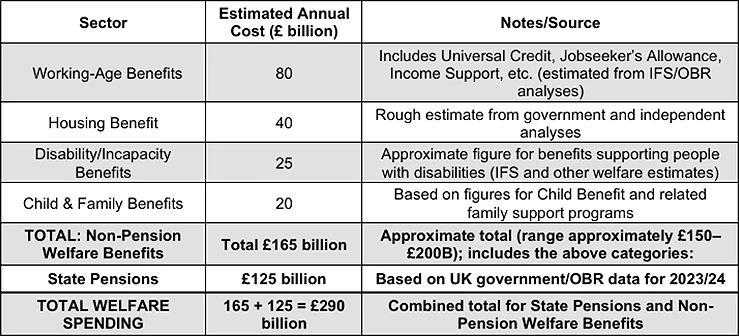
It means the approximately 32 million(3) in employment are contributing more than £5k per annum each towards non- pension welfare costs.
British values support those in genuine need, but there is a growing feeling of being taken advantage of with claimants increasingly described (fairly or not) as ‘scroungers,’ ‘entitled,’ or ‘lazy.’
This is exacerbated as the obligations for this largesse are vague at best or non-existent. E.g. some claimants are expected to ‘actively look for work’, though the 30+ million in employment look for a new job whilst in work.
More could be asked. There remain thousands of roles/tasks in local communities not completed due to a lack of people and/or finance. At the same time, the genuinely vulnerable face a daily financial struggle that could be alleviated if resources were freed up.
“We cannot continue to pour billions into a welfare system that traps people in dependency and penalises work.”
Iain Duncan Smith
What to do?
I remind readers that my aim is to start a conversation. Here goes:
- We need to stop treating all claimants as equal. They are not.
- In return for taxpayer funded support, claimants to be assessed for their ability to contribute to their local community, separating those unable to make any meaningful contribution e.g. severely disabled, those already providing full time contribution such as carer, volunteer (42% of total claimants), and those that can contribute (the remaining 58%)(4). What all the sources are clear on is that we are talking about millions of people.
- The 58% start by contributing a day per week to local communities. This gently ratchets up throughout the claim period, say 2 days per week after 3 months, 3 days after 6 months, and 4 days after one year. It creates a huge pool of available workers: e.g. 2 million claimants helping on average 2 days per week would add the equivalent of 0.8 million full-time workers to support every community in the country.
- Community bodies (e.g. schools, councils, NGOs, charities, etc..) and businesses submit roles that could be filled by claimants based on their skills, ability, and experience (see examples below).
- Claimants and roles are matched by an administrative body (TBD). Funding to administer is described below.
- The scheme would be 100% voluntary, but those not wishing to opt in would see a gradual decline in their benefits, say a reduction of 10% after 3 months, rising to 20% after 6 months. And 35% after 12 months. The reduction would apply if claimants failed to attend sessions or acquire a satisfactory level of performance.
- Claimants benefit from improved mental health and job prospects, it being easier to find work when you’re already active.
Roles
I’d group the roles into two broad categories:
- Group 1: Roles created that otherwise would not exist — but still add value
- Group 2: Roles currently budgeted and filled which could be carried out (or supplemented with) this new supply of workers
Some examples:
Group 1 (mostly requiring CRB checks)
- Helping in schools:
- Running pre and after school clubs for children of working parents, using claimant’s skills and interests (sport, drama, art & craft, etc.) to provide interesting activities for kids.
- Supporting Teaching Assistants with children’s classwork — helping them read, play games, paint, etc.
- Supporting charity work, whether working in a charity shop, helping with aid delivery, or doing shopping for old people.
- Care Homes: providing support for the elderly, washing their hair, painting their nails, and keeping them company.
Group 2
- Maintenance of local parks and green areas
- Picking fruit
- Cleaning public buildings
- Bin collection, road sweeping
- Supplementing existing teams to repair potholes
These may/may not be the best examples, but you get the gist. The training requirement should match the role and the person’s skills. Where clear skills are needed (e.g. fixing potholes), the claimants would supplement and learn from existing teams. Claimants benefit from improved mental health, new skills, and a sense of self-worth. They would be CRB checked when necessary.
The Results
This is a good scheme for taxpayers and welfare recipients who benefit from increased societal engagement and mental health, and raises their chances of employability.
Savings
A mix of ONS and DWP reports(5) put Universal Credit at approximately £10,000 per person, per year and overall welfare of a workless household at approximately £12-15,000 per year. Using the lower £10k number, if one million participants found their way back into employment, the fiscal improvement is approximately £10 billion per annum.
This figure excludes additional tax generation, both PAYE and NI, the levels of which depend on the type of employment. It also excludes benefits to the wider economy of lower borrowing or more spending by the 1 million people. Over time, I expect fewer claimants for two reasons — existing claimants returning to work and fewer new ones (as being on benefits is less appealing).
I stress again the exclusion of those genuinely unable to participate.
To support claimants, we will see in future chapters how we can create thousands of jobs in coastal communities and deprived towns where a disproportionately high number of benefit claimants live.
Some claimants decide the scheme is not for them — a further small saving is made. Some of those that do participate will fill roles currently paid for (e.g. in the example above, rubbish collection, cleaners, park maintenance, fruit pickers).
I am not proposing that any bin men lose their jobs, but rather that through natural attrition, the replacements come from this new pool. This creates a further saving for local authorities.
I propose these savings are split in three ways, providing everyone with an incentive to make the scheme work:
- X% goes to the most vulnerable claimants — a real-term increase for the most vulnerable
- Y% goes to the administration of the scheme
- Z% goes to a reduction in council tax bills
The Results
- Improved fiscal position of £10 billion per annum
- Improved prospects, mental health and sense of contribution for all claimants
- The equivalent of 800k full-time workers supporting local services — already paid for
- Increased payments to the most vulnerable and reduced council tax bills
“We should measure welfare’s success by how many people leave it, not by how many are added.”
Ronald Reagan
( Just) some of the most obvious outstanding questions
- If this isn’t the way to get one million off the welfare list, then what is? Let’s get the conversation started.
- Is there a better way for welfare recipients to contribute in return for their support, improve their mental health and their employability?
- How to fairly assess those that can contribute and those that can’t.
- What are the processes for matching claimants to roles, and who administers this?
- How best to balance the phasing of increased work and reduced benefits to maximise the chances of returning people to paid employment
- What training will be needed for people supervising claimants in new roles