“We want aid spending to deliver more for British taxpayers and support jobs, trade and stability abroad. It’s not just about the amount, but how it’s used.”
Boris Johnson
“Aid helps build the conditions for future trade and investment in emerging markets, creating opportunities for UK businesses.”
UK Department for Business and Trade
To get our financial house in order we want to pull off a magic trick — spending more on international aid, bringing greater benefits to the UK, whilst reducing the cost to UK taxpayers. It means we need to re-think our international aid budget. The examples below will draw on some of the ‘back-of-a-napkin’ ideas from previous chapters.
Context
- In 2013, the UK achieved its goal of allocating 0.7% of GDP to Inter- national aid. This level was enshrined in law in 2015 and equated to between £13-15 billion per year(1).
- The figure dropped to 0.5% of GDP in 2021 in response to the COVID pandemic (2024: c£13 billion), and to 0.3% (approx. £8 billion) in 2025 as funding moved to the Defence budget(2).
- This huge structural change to the Aid sector is replicated across other Western donors. The most extreme example being the dismantling of USAID, eliminating over 5,200 programs (83% of the total) and seeing significant staff reductions(7).
- Aid is channelled through the Official Development Assistance (ODA) framework. The funds are used for humanitarian assistance, poverty reduction, global health initiatives, education, and climate action in developing countries.
- In 2023/24, more than £4 billion (28% of the aid budget) was spent domestically – supporting refugees in the UK, up from £600 million in 2020(3).
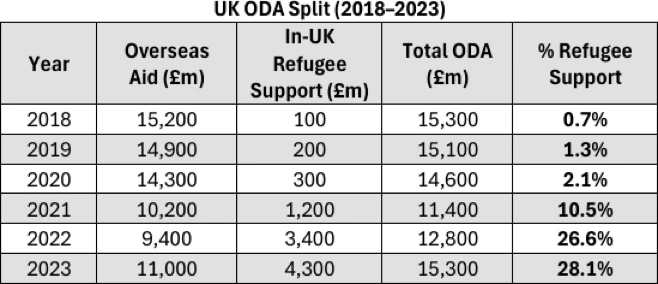
UK Overseas Development Aid spending since 2018
Would a sensible person be interested in:
- Increasing the total aid, we provide whilst reducing the cost to UK government (and therefore the taxpayer) by the current 0.3% GDP spend (saving approx. £8 billion)?
- Using this aid to achieve results the average taxpayer could relate to and be proud of, such as feeding 50 million people per year, shelter, sustainable energy, skills and jobs?
- Growing bilateral trade and opening new opportunities for British businesses?
“We owe it to the taxpayer and to those we aim to help that aid money is spent transparently, effectively, and with proper evaluation.” — Andrew Mitchell, 2022 Chatham House speech
This is how we’d do it
- Repurposing existing aid budget towards building assets shared and managed by the recipient countries and a UK Sovereign Aid Fund (SAF). Assets valued at more than £200 billion in 20 years.
- A vision for these new assets to provide sustainable food for 50 million people per year, plus shelter, energy, and jobs for millions more.
- The ROI on the SAF would be split over time, with half used to increase aid, and the other half to reduce the input from UK taxpayers. In time, the aid budget could grow by 50% whilst reducing the 0.3% of GDP that the British taxpayer pays for it.
- This leads to improved trade and support for British businesses in targeted countries.
“If we withdraw from the world, the world’s problems will not withdraw from us. Aid is one of our tools for shaping a safer, more stable international environment.”
* Lord Hague, former Foreign Secretary
Start a conversation — how it might work?
- Return the domestic spend to something closer to 2020 levels. The UK can never support all refugees. Our strategy must shift to support countries’ domestic development
- Allocate 75% of aid budget (approx. £6 billion pa, £120 billion over 20 years) to targeted countries with less, larger grants from a discretionary fund
- Ring-fence the remainder for emergency spending (approx. £2 billion) and key, non-controversial projects like the GAVI, the global health initiative to increase immunisation in low-income countries.
- Projects would have to give practical assistance to recipient coun- tries/people alongside the creation of viable assets. What does this mean? Rather than spend £1 million on food, spend £1 million on a farm. Any immediate short-term emergency could be met with the £2 billion emergency funding, allowing the longer-term benefits of the farm asset to be funded by the £6 billion discretionary fund
- Countries/people need sustainable food, energy, housing, sanitation, healthcare, and infrastructure. By investing in these areas, we would create lasting improvement and a long-term asset. The assets could be split with the recipient country, growing their national wealth. The remainder would form part of the UK Sovereign Aid Fund.
- Countries could bid for multi-year funding packages with weighting to support bilateral imports/exports via trade agreements.
- Billions invested in targeted countries should create thousands of local jobs, transfer skills, improve the economy and build momentum for further development. Our new assets would benefit from this growth.
- British firms, innovation, and expertise would have a leading role in projects, accelerating their growth in important markets.
- Over 20 years, £6 billion of discretionary funding creates a pool for assets in today’s money of £120 billion. A 25% share of the assets gifted to recipient countries would leave the UK with a SAF of the remaining 75% or £90 billion. That pool of assets would grow at compound rates.
If there is agreement to create shared assets with recipient countries, then the next step is to agree those assets based on the benefits they bring local populations. Let’s look at some examples.
Four back-of-the-napkin examples
Aquafarming
“If reformed and properly regulated, aquaculture could offer a low-carbon alternative to intensive farming and help feed the planet without frying it.”
Guardian Editorial, 2021
We saw in one earlier chapter how the UK could use just 1% of its Exclusive Maritime Zone to become a global leader in Aquafarming, and in a second chapter a leader in renewable energy. The UK could use this leadership to provide sustainable food (fish, shellfish & seaweed), jobs, support for net-zero, through carbon capture and biofuel. We’d have the expertise, and if the Aid budget could be used, we’d have the funding. Each sq. km (100 hectares) of aquafarm in Africa costs between £0.2-1.2 million to set up depending on location and conditions(4). Assuming £1.0
million per 1 sq. km, 25% of our discretionary £6 billion fund could create 1,500 sq.km of aquafarming per annum, or 15,000 sq.km over 10 years. The World Bank’s ‘Fish to 2030’ report suggests between 1,500 to 2,500 tonnes of food could be harvested per sq. km. The food either feeds the local population or can be sold. By reinvesting the returns from these farms, the area (and the returns) continue to grow.
Carbon Capture
In addition, these farms help achieve net-zero through carbon sequestration. Millions of tonnes of carbon would be negated. After 10 years investment this would make significant inroads into the UK’s annual emissions, allowing the UK to dial down some of the more expensive measures introduced at home.
This is not wishful thinking. Earlier chapters described how the Dutch are currently exploring the largest aquafarm in Europe, with a 400 sq. km project in the North Sea– Imagine if the UK could have a 75% share of farms twenty times the size, fully funded.
As well as feeding millions of people in some of the poorest countries, they would support local jobs and trade. Crucially, and this is the real change in the current aid model, they would generate a financial return. The variables are considerable, but my back-of-the-napkin research suggests they are substantial.
Those returns allow two things — sustainable increases in aid spending, and the ability to reduce the burden of international aid on the UK taxpayer (currently 0.3% of GDP) — over time, a reduction in our annual borrowing requirements of approximately £8 billion. With British businesses supporting delivery, other opportunities for UK trade would open, and it will be the British leading a drive to increase international aid through a more sustainable model.
Most people would buy into that vision.
- Energy: Linking with another previous chapter, there are two ways our discretionary fund could supply sustainable energy to the poorest countries. These are not the only ways, but they are two examples that might start a conversation.
- Bio-fuel: One of the primary uses of our seafood crop is biofuel. Once food requirements have been met/exceeded, and as ROI on our farms allows ever greater scaling, there’d be no shortage of sustainable fuel. We could use a further 25% of our discretionary fund — £30 billion over 20 years — to invest in biofuel power stations.
As before, the UK SAF benefits from 75% of this investment (£22 billion). Local countries are gifted the remaining 25%, as well as gaining jobs, skills and of course, green energy. UK returns on this investment split as before — on increased aid and lowering UK tax/borrowing burden.
Crucially, not only are these initiatives fully funded, but they also boost the case for biofuel power stations in the UK as they are a pilot for the scale required to bring the cost down. As above, British industry benefits from leading these and other projects.
“Sustainable aquaculture can help meet the rising global demand for protein while offering jobs, especially in rural and coastal communities.”
Fish to 2030 Report, World Bank, 2013
Ditto for Small Modular Nuclear Reactors (SMRs).
The previous energy chapter highlighted recent government support for this technology. As I write, decisions will soon be made on who will supply these in the UK as part of our secure energy mix. The size and cost of the main contenders vary. Rolls Royce leads the British option, where at scale each costs £2 billion and powers approximately 1.1 million homes.
Allocating 25% of our £6 billion per annum over 20 years creates a fund of £30 billion. I’ll keep saying it — by repurposing existing aid, it’s all fully funded. Using British expertise and technology, and if security concerns could be overcome, we could build 15 reactors. The generated ROI means UK SAF would have a stake in one of the largest new energy companies in developing countries. Further, I would expect this initiative to drive demand for further British SMRs in recipient and other developing countries, as well as driving down the price for implementation in the UK and overseas.
Energy majors receive returns on their investments in emerging economies of between 8% (coal),12-18% (natural gas), 10–20% (energy grid & transmis- sion) and 8–25% for renewable energy. It means our £30 billion investment, with a modest 10% return, would generate £3 billion per annum for the Exchequer, plus give British companies a massive boost in emerging markets.
And finally — affordable housing.
The final 25% of our £6 billion per annum investments would create a £30 billion fund over 20 years to build safe, sustainable homes. Given the increasing demand in strategically important countries in Asia, Africa, and South America, the boost to local economies and job creation would get local government support.
The SAF benefits from regular rental income and capital appreciation, where average returns are:
- In India: Annual appreciation of 11.6% between 2010 and 2020, (3), plus rental yields of 3.5% to 4%.(4)
- In South Africa: Annual appreciation of 3.5%(5), with rental yields of 10%.(6)
- In Egypt, returns over the last few years have averaged 8-12% per annum.
It means a conservative 5% return on our £30 billion residential property investment would generate £1.5 billion a year. Plus, British companies would get a strong foothold in some of the fastest-growing economies.
The Numbers
- £6 billion of existing spend in 2025 terms is invested each year, funded by the UK taxpayer
- ROI is set at a conservative 6% per annum and comes online one year in arrears
- The ROI is reinvested the following year
- It means £120 billion over 20 years in our discretionary fund swells to £203 billion
- The ROI in Year 20 is £11 billion. It means the UK’s contribution to international aid will have increased approximately 50%, and be fully funded by the SAF, freeing up the current 0.3% contribution to lower the tax burden or borrowing requirements.
( Just) some of the most obvious outstanding questions
- Why shouldn’t the UK benefit more from a change in aid spending if the overall amount spent on aid increases?
- How to balance the shift away from immediate spending requirements to strategic initiatives that help solve underlying problems over time, but at the cost of impact on real people?
- With a shift towards investing in assets, would it be possible to leverage the UK spending commitments with additional, external investment, meaning an immediate increase in overseas investment?
- The business model for the underlying asset. This is NOT a wheeze to extort the recipient (although that is how some donors operate). Rather, in the long run, we support ever-more people, fully funded, solve strategic problems, support British business, and get the UK back to leading the world on international development.
References
- Institute for Fiscal Studies (2017). ‘The changing landscape of UK aid.’ Available at: https://ifs.org.uk/publications/changing-landscape-uk– aid
- Hughes, S., Mitchell, I., Tyskerud, Y. and Warwick, R. (2021). ‘The UK’s reduction in aid spending. Center for Global Development.’ Available at: https://www.cgdev.org/publication/uks-reduction-aid-spending
- Hughes, S. and Mitchell, I. (2024) ‘How much UK aid will Labour divert to refugee hosting in 2024?’ Available at: https://www.cgdev.org/blog/ how-much-uk-aid-will-labour-divert-refugee-hosting-2024
- Msuya, F.E., Bolton, J., Pascal, F. et al. (2022) ‘Seaweed farming in Africa: current status and future potential.’ JournalofAppliedPhycology, 34, pp.985–1005. Available at: https://link.springer.com/article/10.1007/ s10811-021-02676-w
- World Bank (2023) ‘Global Seaweed New and Emerging Markets Report 2023.’ Available at: https://www.worldbank.org/en/topic/environm ent/publication/global-seaweed-new-and-emerging-markets-report– 2023
- Reef Resilience Network (2022) Tanzania – Aquaculture. Available at: https://reefresilience.org/case-studies/tanzania-aquaculture/
- APNews(2025). ‘Secretary of State Rubio says purge of USAID programs complete, with 83% of agency’s programs gone.’ Available at: https://ap news.com/article/trump-musk-rubio-usaid-foreign-aid-bf442d62af6 7918a6fc5eee839074601